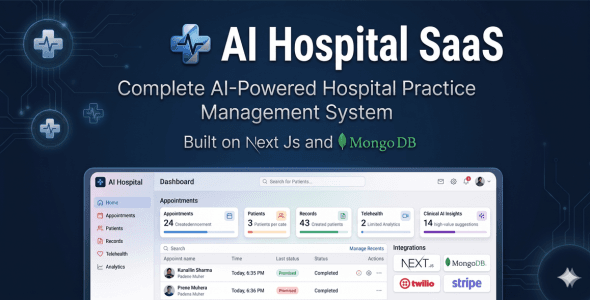
AI Hospital SaaS - Complete AI Powered Healthcare / Hospital Management System (HMS) | Node JS | SaaS
AI Hospital SaaS is a production-ready, multi-tenant SaaS platform built for hospitals and clinic networks. It delivers a single deployable application where each hospital operates as its own tenant—own subdomain, staff users, patient records, lab devices, billing, and settings—with strict organizational isolation. Built on modern Node.js tooling (Next.js API routes and server runtime), it combines traditional HMS depth with optional Stripe-based subscriptions for operators who sell plans and onboard facilities online.
The product targets operators running a hosted HMS business as well as enterprises standardizing many sites on one codebase. Clinical teams use their hospital URL daily; platform administrators manage tenants, plans, and governance from the apex console.
Demo credentials
Platform admin
Sign in here: https://codearistos.store/
- superadmin@aidoc.com — password123
Hospital login
Sign in here: https://demo.codearistos.store/
- admin@aidoc.com — password123
Use Platform admin credentials only on the apex link above; use Hospital login credentials only on the hospital demo subdomain.
Multi-tenant SaaS architecture
- One application, many hospitals: Each facility is an organization with isolated data scoped by tenant.
- Subdomain tenancy: Staff and patients typically sign in from hospital-specific hosts (for example your hospital subdomain plus your apex domain in production); this binds sessions and APIs to the correct organization.
- Platform vs hospital roles: A superadmin operates the whole SaaS deployment (plans, tenants, platform tools). Hospital admins, doctors, nurses, staff, and patient-portal users belong to a single tenant.
- Subscriptions: Optional Stripe checkout and webhooks support self-serve signup and recurring billing; hospital admins may renew from billing settings when operators enable this.
Stripe payments for subscribers: When enabled, hospitals (your SaaS customers) pay the platform operator through Stripe Checkout—typically selecting a plan at signup—with webhooks updating subscription status after successful payment. Recurring SaaS billing and renewals are handled in Stripe; hospital administrators use in-app billing settings to manage their subscription with your platform. This is not the same as patient invoices inside each tenant’s HMS.
Clinical and operational modules
The HMS spans front-office and back-office workflows so hospitals can register patients, schedule care, document encounters, bill services, and operate ancillary departments without stitching multiple products together.
- Patient management: Registration, demographics, medical history, search and profiles; ties into appointments and billing.
- Appointments: Scheduling, statuses, doctor linkage, and operational views.
- Medical reports & documentation: Structured reporting aligned with clinical workflows.
- Doctors & staff: User provisioning with role-based permissions inside each tenant.
- Laboratory (LIS-style): Orders, results, catalogs/templates where configured; supports analyzer-centric workflows.
- Radiology & imaging: Study tracking with DICOM-oriented integration paths for modalities such as CT, MRI, X-ray, and ultrasound.
- Inpatient: Admissions, wards, and bed-oriented flows where deployed.
- Pharmacy & dispensing: Medicines master data and dispensing queues linked to clinical activity.
- Inventory & procurement: Suppliers, stock items, and purchase orders.
- Billing & invoices: Patient-facing invoicing and payments inside the HMS (distinct from the operator’s SaaS subscription).
- Documents: Upload and categorize files with optional patient linkage.
- Emergency & ambulance: Emergency cases and ambulance bookings/fleet-oriented views.
- Telemedicine: Scheduled sessions with video/audio/chat patterns and clinical notes.
- Dental, labour & theatre (where enabled on your deployment): Specialized workflows extending the core HMS footprint.
- Patient portal: Secure patient-facing areas for appointments, records, prescriptions, lab visibility, invoices, and telemedicine according to configuration.
- Analytics & dashboards: Operational summaries for administrators and analysts.
Device & interoperability integration
- LIS connectivity: Laboratory analyzer integration via industry protocols including HL7-style messaging, FHIR endpoints for ingest, and ASTM framing—suited for hematology, chemistry, and related instruments.
- DICOM workflows: Imaging pipeline hooks for modalities feeding radiology modules.
- FHIR APIs: REST-style ingestion paths for interoperable payloads where deployed.
AI-assisted features
AI capabilities act as decision support alongside clinician judgment—not as autonomous diagnosis. Typical surfaces include conversational assistance, structured suggestions, imaging-oriented assists where configured, scheduling aids, documentation helpers, risk-oriented summaries, analytics narratives, and symptom-oriented tooling. Operators configure AI keys per tenant or globally depending on deployment practice.
Internationalization & usability
- Multiple languages: UI messaging through localized bundles where enabled.
- Responsive web UX: Browser-based access for desktops and tablets common in wards and admin offices.
Security & governance
- Authentication: Session-based auth suitable for SaaS multi-host setups when environment variables follow deployment guides.
- Authorization: Role-driven access separating platform operators from tenant staff and patients.
- Password hygiene: Stored credentials use modern hashing practices suitable for healthcare SaaS.
Ideal buyers
- SaaS vendors selling HMS subscriptions to independent hospitals.
- Hospital groups wanting standardized software across branches with tenant isolation.
- Digital health integrators needing LIS/DICOM-aware HMS plus APIs.
Documentation
For installation, environment variables (MongoDB, NextAuth, Stripe, tenancy hosts), seed scripts, and operator guidance, see full product documentation.
Technology stack
The application is a Node.js server-side stack centered on Next.js (App Router and API routes) with React and TypeScript for type-safe UI and backend handlers. Data persists in MongoDB via Mongoose; authentication uses NextAuth.js with patterns suited to multi-host SaaS deployments.
- Frontend: React, Tailwind CSS–based styling, responsive layouts
- Backend: Next.js API routes and server runtime on Node.js
- Database: MongoDB with Mongoose models scoped per tenant where applicable
- Auth: Session-based login with bcrypt password hashing
- SaaS billing (optional): Stripe Checkout and webhooks for plans and subscriptions
- Interoperability: FHIR-oriented HTTP endpoints; optional HL7 and ASTM listener services for laboratory device integration where enabled
- Internationalization: Message catalogs for multiple languages
Exact dependency versions and security posture are summarized in the shipped documentation and lockfile when you deploy from source.